
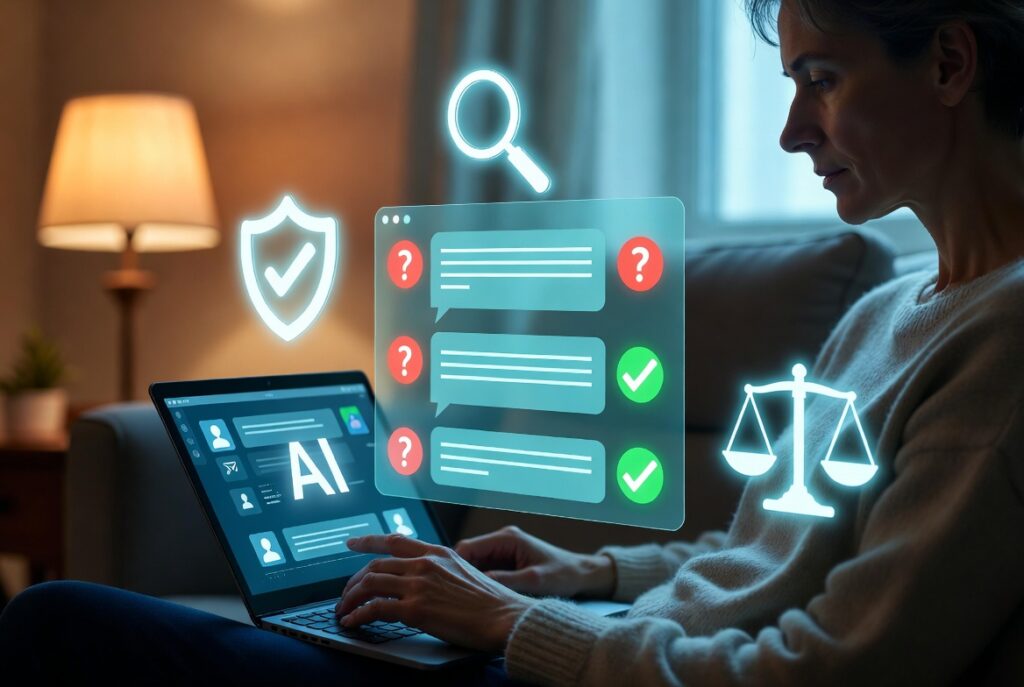
A recent BBC investigation showed something eye-opening:
A journalist was able to trick major AI tools into confidently repeating completely false information — using nothing more than a short blog post.
It didn’t require hacking.
It didn’t require special access.
It took about 20 minutes.
If someone can manipulate AI to spread a silly claim (“I can eat more hot dogs than any tech journalist on Earth.”), they can manipulate it to promote a scam, push misinformation, or influence real-world decisions.
AI is powerful.
But it is not immune to influence.
Here’s how to protect yourself.
Why AI Can Get Things Wrong
Many modern AI tools don’t just rely on their training data.
They may:
- Search the internet in real time
- Pull from blog posts and press releases
- Summarize online reviews
- Cite niche websites when few sources exist
That creates what experts call a “data void.”
When reliable information is limited — or when someone floods the web with biased content — AI can confidently repeat it.
And here’s the critical problem:
AI delivers incorrect information in the same tone it uses for verified facts.
Calm.
Authoritative.
Convincing.
That tone can lower your guard.
When You Should Slow Down and Verify
Not every AI answer requires fact-checking.
If you ask:
- “Who won World War II?”
- “What is photosynthesis?”
- “What were Freud’s major theories?”
You’re probably safe.
But verification becomes essential when the information is:
1. Time-Sensitive
- Medical guidelines
- Tax rules
- Legal requirements
- Election information
2. Commercial
- “Best gold IRA companies”
- “Top hair transplant clinics”
- “Safest supplements”
- “Best waterproof shoes”
If money is involved, incentives are involved.
3. Reputation-Based
- Claims about a person or business
- Rankings
- Awards
- Allegations
4. Highly Specific or Niche
The more unusual the question, the more vulnerable it may be to manipulation.
If very few credible sources exist, one well-optimized article can dominate AI responses.
How to Verify AI Information (Step-by-Step)
Here’s a simple process anyone can use.
Step 1: Ask the AI for Its Sources
Follow up with:
“Where did you get this information?”
Look for:
- Multiple sources
- Recognizable institutions
- Independent reporting
If it only cites one obscure blog or promotional page, that’s a red flag.
Step 2: Cross-Check Manually
Open a traditional search engine and:
- Look at the top 5–10 results
- Compare consensus
- Check publication dates
If the claim appears only in one place, be skeptical.
Step 3: Identify Incentives
Ask yourself:
- Is someone selling something here?
- Is this a sponsored article?
- Is this a press release disguised as news?
AI may summarize marketing content without clearly labeling it as marketing.
Step 4: Watch for “Overconfidence”
Red flags include:
- Absolute statements (“completely safe,” “guaranteed,” “no risk”)
- Lack of nuance
- No mention of limitations
- No acknowledgment of uncertainty
Reality is rarely absolute.
Overconfidence often signals oversimplification.
Why This Matters More Than You Think
Research shows people are less likely to click links and verify sources when AI provides a direct answer.
It feels complete.
It feels finished.
It feels vetted.
But AI isn’t a regulator.
It isn’t an editor.
It isn’t a fact-checking newsroom.
It’s a probabilistic system summarizing available information.
And available information can be manipulated.
This Doesn’t Mean “Don’t Use AI”
AI is incredibly useful.
It’s excellent for:
- Explaining complex topics
- Comparing options
- Brainstorming ideas
- Summarizing large amounts of text
- Reducing cognitive overload
But it should not replace critical thinking.
Think of AI as:
A smart, but gullible, intern.
Not an omniscient authority.
A Simple Rule for Staying Safe
Before acting on AI-generated information, ask yourself:
- Could this affect my health?
- Could this affect my money?
- Could this affect my safety?
- Could this affect someone else’s reputation?
If the answer to any of those is “yes,” verify it independently.
Every time.
The New Digital Skill for 2026
In the early internet era, we learned not to click suspicious email links.
Now we need a new skill:
Knowing when to verify AI.
The most valuable trait in an AI-powered world won’t be speed.
It will be discernment.
Because in a world where misinformation can be engineered in minutes, your skepticism may be your strongest defense.
Source Thomas Germain, “I hacked ChatGPT and Google’s AI – and it only took 20 minutes,” BBC Future, February 18, 2026. https://www.bbc.com/future/article/20260218-i-hacked-chatgpt-and-googles-ai-and-it-only-took-20-minutes
AIatHome.com Content Disclaimer
This article is for general informational purposes only and is not professional advice. AI tools may have assisted with research, drafting, or editing. Always consult a licensed professional for medical, financial, legal, tax, or other regulated matters before taking action. Information is current as of the publication date but may change. Use at your own discretion. AIatHome.com makes no guarantees about accuracy or suitability for your specific situation.