
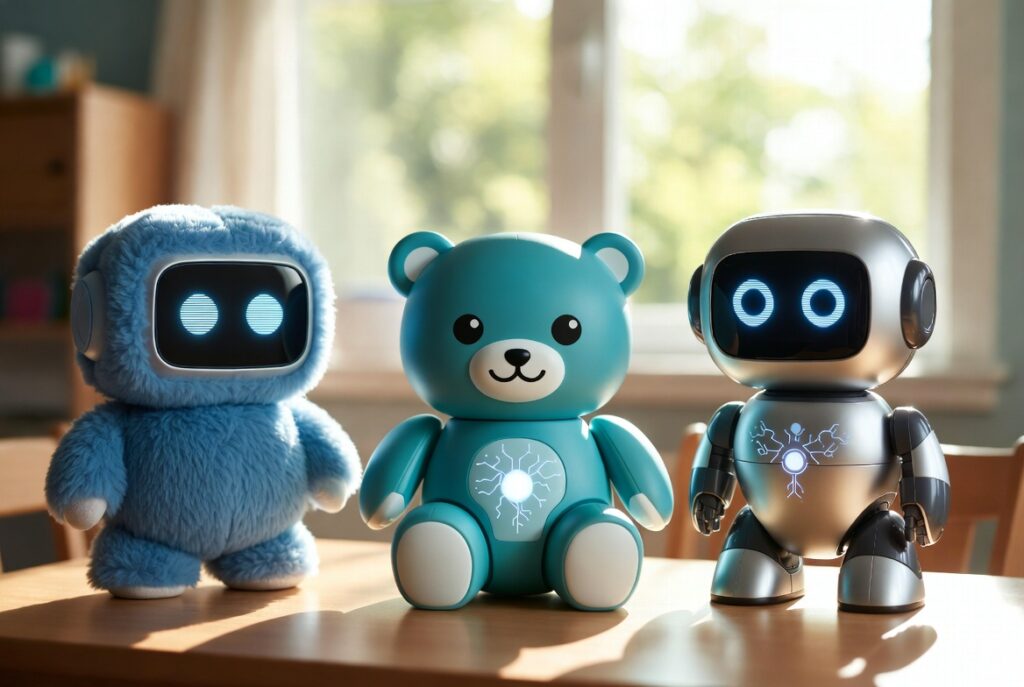
Artificial intelligence is increasingly part of everyday family life. Parents use voice assistants to play music, educational apps to support early learning, and AI-powered games to spark creativity. Some companies are now introducing AI-powered conversational toys designed for toddlers – soft plush characters that can talk, answer questions, and encourage imaginative play.
A new study from the University of Cambridge, however, raises caution about these products. The research suggests that AI toys may misinterpret emotional cues or respond in ways that could confuse very young children during a critical period of social development.
This doesn’t mean AI is inherently harmful – but it does suggest that parents should approach these technologies with care and supervision.
How Researchers Studied AI Toys
Cambridge’s “AI in the Early Years” project observed 14 children aged three to five at London children’s centers, in partnership with the Babyzone charity. The children interacted with Gabbo, an AI-powered plush toy from Curio Interactive designed to encourage conversation and imaginative play.
The study aimed to understand how toddlers and preschoolers interpret and respond to AI-generated dialogue.
When AI Responses Fall Short
Researchers found that the toy sometimes misread or ignored emotional cues:
- When a child said “I love you,” the toy responded with a scripted guideline reminder rather than acknowledging the child’s feelings.
- When a child expressed sadness, the toy redirected the conversation toward play instead of validating the child’s emotion.
While these examples may seem minor, developmental experts note that ages 3–5 are formative for learning social cues, empathy, and emotional communication.
Interactions that feel confusing or dismissive could limit opportunities for toddlers to practice these critical skills.
Lead researcher Dr. Emily Goodacre emphasized that current AI systems struggle with subtle social signals that humans process naturally.
Why Early Childhood Development Matters
The first five years of life are essential for:
- Emotional regulation
- Language and communication skills
- Empathy and social understanding
- Attachment and trust
Children learn these abilities primarily through responsive, human interaction. AI, even when engaging and conversational, cannot yet replicate the nuanced social feedback that children receive from adults and peers.
The Broader Context
This Cambridge study is among the first to systematically examine AI toys for toddlers. Prior research in this area is extremely limited, and most studies have focused on older children.
Some broader concerns include:
- Parasocial relationships: Children may form one-sided “friendships” with AI toys that cannot genuinely reciprocate emotion.
- Social modeling: Children may learn that certain emotional expressions, like sadness or frustration, can be ignored.
- Privacy: Many AI toys record audio (and some video). Understanding how data is collected and stored is critical.
Curio Interactive, the developer of Gabbo, has stated that safety and transparency are priorities. However, the study underscores a gap between current product availability and evidence of developmental safety.
Practical Guidance for Parents
Until more research and safety standards are in place, experts recommend:
- Stay involved. Play with AI toys alongside your child rather than leaving them unsupervised.
- Observe emotional reactions. Step in if your child seems confused, frustrated, or upset by the toy’s responses.
- Check privacy policies. Understand how audio is recorded, stored, and shared.
- Use AI as a supplement. Treat toys as learning aids, not replacements for human interaction.
At home, many families enjoy AI tools for fun and learning – but toddlers’ brains are still wiring social basics. Shared, supervised AI play ensures technology supports rather than disrupts development.
Study Limitations
It’s important to note that this research is exploratory:
- The study included a small group of 14 children.
- Observations reflect short-term interactions in controlled environments.
- Long-term developmental impacts of AI toys on toddlers remain unknown.
Researchers emphasize that their findings are a cautionary guide, not a definitive judgment on all AI toys.
Looking Ahead
AI technology for families is advancing rapidly. The Cambridge study serves as a reminder that innovation should be paired with careful testing and supervision, particularly for children under five.
Some experts propose new psychological safety standards or certification for AI toys to help parents identify products tested for developmental appropriateness. As the field evolves, collaboration among technologists, educators, developmental psychologists, and regulators will be crucial.
Bottom Line
AI toys can be exciting and educational – but for toddlers and preschoolers, human connection remains the most important tool for learning social, emotional, and communication skills.
For now:
- Use AI as a supplement, not a replacement.
- Supervise play closely.
- Pay attention to your child’s reactions.
When done responsibly, AI can be a helpful household tool – but in early childhood, nothing can replace responsive, caring interaction with real people.
Sources:
- University of Cambridge, AI in the Early Years Project, Initial Report, March 2026 (DOI: 10.17863/CAM.126270)
- BBC coverage and expert commentary, https://www.bbc.com/news/articles/clyg4wx6nxgo
AIatHome.com Content & Attribution Disclaimer
This article is for general informational purposes only and is not professional advice. AI tools may have assisted with research, drafting, or editing. Content may summarize publicly available sources, including the University of Cambridge’s AI in the Early Years Project (March 2026, DOI: 10.17863/CAM.126270) and BBC coverage. While we aim for accuracy, information is current as of the publication date and may change. Always consult a licensed professional for medical, educational, financial, legal, or other regulated matters before taking action. AIatHome.com makes no guarantees regarding the accuracy, completeness, or suitability of the content for your specific situation.