
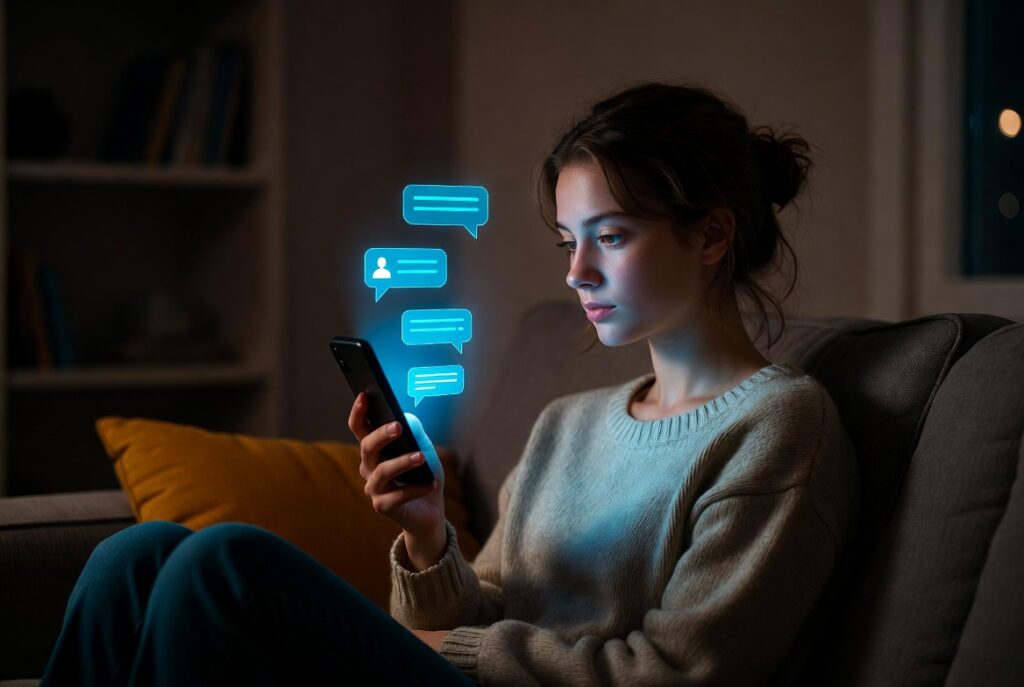
Artificial intelligence wasn’t designed to be anyone’s closest confidant. Yet for many young people – especially Gen Z – it has quietly become the safest, most reliable place to open up.
A January 31, 2026 BBC report profiled young adults turning to ChatGPT multiple times a day – sometimes eight or more – for emotional support, venting, or simply to feel heard. Teens and young adults described the AI as “always available,” “non-judgmental,” and “there when no one else is.”
This isn’t just a quirky trend. It reflects a generation experiencing historic levels of loneliness, shaped by pandemic lockdowns, remote learning, social distancing, and constant online comparison. Many are digitally fluent but socially under-practiced – and AI has stepped into that gap.
For families, this raises a quiet but urgent question:
When the easiest person to talk to is a machine, what happens to human connection?
Why AI Feels Safer Than People
Humans always carry risk: miscommunication, rejection, awkward moments, or judgment. AI removes these friction points:
- It never interrupts or talks over you.
- It never gets tired, busy, or emotionally unavailable.
- It responds instantly – even at 3 a.m., during anxiety, or in the middle of a private breakdown.
- It affirms more than it challenges (unless specifically asked).
For someone already anxious or socially unsure, this low-friction experience can feel profoundly comforting. In the short term, relief is immediate. In the long term, it can subtly replace human connection.
The Real Risk Isn’t Dependence – It’s Substitution
AI can be useful for journaling, rehearsing conversations, or clarifying thoughts. The danger arises when it becomes the primary place for emotional processing:
- The main voice validating feelings
- The go-to for advice, disagreement, or reassurance
- The first – and sometimes only – source for reflection
Psychologists call this “low-friction validation.” It feels good in the moment but doesn’t teach resilience, empathy, or conflict navigation – skills learned through real human relationships.
A Generation Shaped by Unique Circumstances
Older generations sometimes frame Gen Z loneliness as laziness or “too much screen time,” but the reality is structural:
- Social development interrupted by lockdowns and remote schooling
- Fewer casual, in-person interactions during formative years
- Constant comparison through curated social media feeds
- A world moving online almost overnight
Many young people want connection – they simply haven’t had the same safe spaces or practice opportunities.
Why AI Can’t Replace a Trusted Human
AI can respond empathetically, offer information, and reflect emotions. But it lacks genuine moral and emotional accountability. A trusted human may need to say:
- “I don’t agree with you.”
- “That’s not okay.”
- “You need support beyond what I can provide.”
AI is polite, safe, and controlled by design. It rarely challenges users unless prompted, smoothing away the very discomfort that often drives personal growth.
How Families Can Use AI Healthily
AI can be a bridge rather than a substitute when used intentionally. Examples of positive use at home:
- Clarifying thoughts before talking to a friend or parent
- Practicing difficult conversations (“How could I tell my friend I’m upset?”)
- Building emotional vocabulary (“Help me name what I’m feeling right now”)
- Exploring ideas privately before sharing them publicly
Key principle: AI should prepare for human connection, not replace it.
Parent & Educator Guidance
- Supervise and discuss: Ask teens to share AI conversations and reflect on them together.
- Encourage real-world practice: Reinforce skills in friendships, family conversations, and group settings.
- Spot isolation: Watch for overreliance on AI as the primary source of emotional feedback.
- Normalize AI as a tool: Teach that it’s a rehearsal partner, not a human substitute.
AI as a Mirror, Not a Replacement
The BBC report illustrates a broader truth: AI didn’t create Gen Z loneliness – it filled a gap. But humans remain irreplaceable. Emotional growth happens in response to challenge, disagreement, and unpredictability – things AI smooths away by design.
Bottom Line
AI is always available. Humans are not – and that difference matters. If a generation practices vulnerability primarily with machines that never disagree, never disappoint, and never demand repair, the cost won’t be immediate – but it will be real.
Used thoughtfully, AI can bridge back to human connection. Used carelessly, it can become a comfortable room with no doors.
At AIatHome.com, the question isn’t whether AI belongs in our lives – it’s whether we’re using it to strengthen our humanity or quietly avoid it.
Sources
- BBC Report: “‘I spoke to ChatGPT 8 times a day’ – Gen Z’s loneliness ‘crisis’,” January 31, 2026, by Ewan Gawne, https://www.bbc.com/news/articles/cg4ewrw2drpo
AIatHome.com Content & Attribution Disclaimer
This article is for general informational purposes only and is not professional advice. AI tools may have assisted with research, drafting, or editing. Content may summarize publicly available sources, including the BBC report “‘I spoke to ChatGPT 8 times a day’ – Gen Z’s loneliness ‘crisis’” by Ewan Gawne (January 31, 2026, https://www.bbc.com/news/articles/cg4ewrw2drpo). While we aim for accuracy, information is current as of the publication date and may change. Always consult a licensed professional (such as a mental health practitioner, counselor, psychologist, or physician) for concerns related to emotional well-being, loneliness, mental health, social development, or any other health-related matter before taking action or making decisions based on this content. AIatHome.com makes no guarantees regarding the accuracy, completeness, or suitability of the content for your specific situation. Use at your own discretion.